PhD Candidate in Strategy · Michigan Ross
Kyle Emory McCullers
I study how culture, identity, and activism shape the strategic choices that organizations and entrepreneurs make.

I study how culture, identity, and activism shape the strategic choices that organizations and entrepreneurs make.
I am a PhD candidate in Strategy at the University of Michigan's Ross School of Business. I study how entrepreneurs with marginalized identities decide whether to make those identities part of their competitive positioning, and why the same identity can be an asset in one market and a liability in another.
Some businesses announce that they are Black-owned, women-owned, or veteran-owned. Most owners who hold the same identities say nothing. My research investigates:
I combine large-scale digital trace data, administrative records, interviews, and experiments.
Competitive Positioning on Owner Social Identity
Every business owner has an identity, yet not all business owners disclose theirs to the market. Among owners whose identities have historically been bases for discrimination — marginalized identities — more than one in ten disclose, an empirical fact I document with nationally representative data.
We consider how entrepreneurship and employment differentially shape opportunities for social mobility across people and contexts. Specifically focusing on changes in an individual’s social status, or vertical mobility, we propose three metaphors for studying entrepreneurship: (1) production (i.e., increased status); (2) preservation (i.e., maintained status); and (3) consumption (i.e., decreased status). Each metaphor features theoretical mechanisms that account for how founding an organization can facilitate inter-occupational transitions and, thus, enable status mobility. We offer a proposed research agenda for studying entrepreneurship’s role in social mobility processes, including mechanism-specific propositions at the individual and population levels of analysis as well as guidance on sampling and measurement.
The traditional macroeconomic approach to poverty alleviation in neighborhoods and communities is to use housing development and job-creation programs to address the income and the opportunity gaps. Entrepreneurship is a much less used poverty alleviation strategy that, in our estimation, can have a significant effect in favorable policy environments. After a brief literature review, we highlight policy approaches that use entrepreneurship as a poverty alleviation strategy. We present several case studies from the United States as evidence of how public policy can empower an entrepreneurial ecosystem to support the self-employed and other low-income entrepreneurs. We conclude with a framework for how public policy can alleviate poverty through entrepreneurship that is generalizable in other contexts.
Every business owner has an identity, yet not all business owners disclose theirs to the market. Among owners whose identities have historically been bases for discrimination — marginalized identities — more than one in ten disclose, an empirical fact I document with nationally representative data.
Extends the strategic identity disclosure framework to romantic markets, examining how entrepreneurial identity functions as a signal and how its meaning varies by race, gender, and cultural context.
Supported by the Empowering Research with AI Award, AI Institutes at Michigan (2026).
When owners make race, gender, sexuality, or veteran status visible to customers, and what explains why most do not.
How solidarity within and across communities shapes the market for Black-owned businesses.
Whether and for whom entrepreneurship works as a path to social mobility and out of poverty.
How entrepreneurship and activism shape each other: when business becomes a vehicle for social change, and how movements shape the businesses around them.
An open dataset of 36,928 verified Black-owned U.S. businesses. I built it and released it openly so other researchers studying minority entrepreneurship can use it too.
Before Michigan, I spent more than a decade in New York's media, hospitality, and real estate industries: in magazine advertising at Vibe, Giant, and UPTOWN, and at Union Square Hospitality Group, where I was the inaugural chair of its Diversity & Inclusion Council.
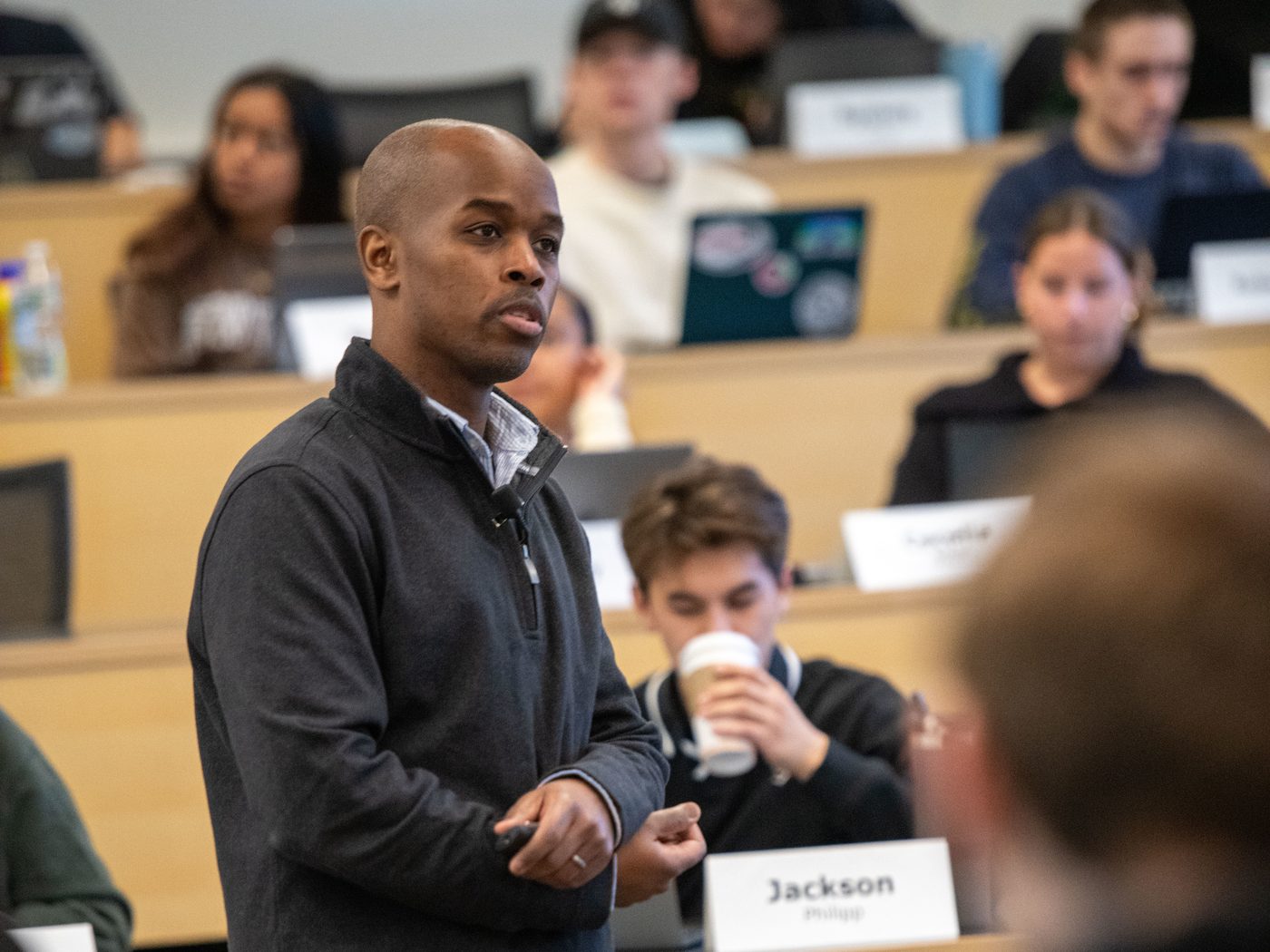
As primary instructor for Business Strategy at Ross, I earned a 5.0/5.0 student evaluation and the Gerald and Lillian Dykstra Fellowship for teaching excellence. Student teams consulted directly for a live client, presenting market-entry recommendations to its founders.
Stephen M. Ross School of Business, University of Michigan
701 Tappan Avenue, Ann Arbor, MI 48109